
Table of Contents
- At a Glance
- What Is Aura Without Headache?
- Why Can Aura Occur Without Pain?
- Is Aura Without Migraine Usually Dangerous?
- When Aura May Need Closer Attention
- How Aura Differs from Other Neurological Events
- Why Aura Can Occur More Frequently Over Time
- The Role of Energy, Metabolism, and Oxidative Stress
- Why Aura Patterns Matter More Than Individual Episodes
- Supporting Brain Stability with Brain Ritual®
- Final Thoughts
At a Glance
|
Migraine aura without headache, sometimes referred to as a silent migraine, often feels unusual because it occurs without the head pain typically associated with migraine. It often involves visual disturbances, but may also include tingling sensations or brief changes in speech.
Because these symptoms occur without head pain, they can feel difficult to interpret. This is why many people find themselves wondering: is aura without migraine is dangerous?
In most cases, these experiences reflect temporary changes in brain activity rather than a problem with the eyes or a structural issue within the brain. The symptoms arise from changes in how the brain processes information and tend to follow a gradual and recognizable pattern.
Understanding how silent migraines behave over time helps place these experiences in context.
What Is Aura Without Headache?
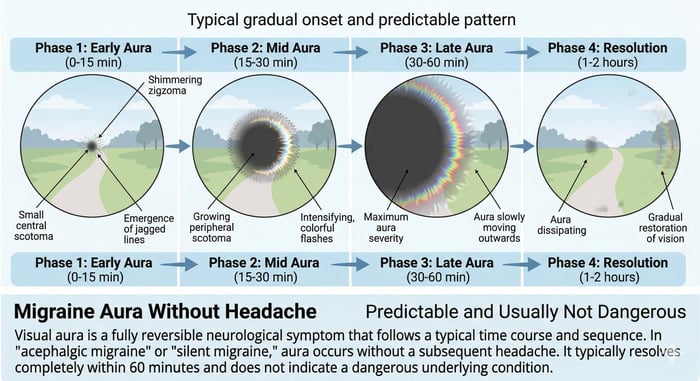
Migraine aura is a temporary change in brain activity that can affect vision, sensation, or language. It is most commonly experienced as visual disturbances such as shimmering patterns, zigzag lines, flashing lights, or blind spots, but can also include tingling sensations or brief difficulty with speech. These symptoms typically develop gradually, evolve over several minutes, and then fully resolve.
It is estimated that around one in four people with migraine experience aura at some point. Aura without headache is less common, but follows the same underlying brain processes.
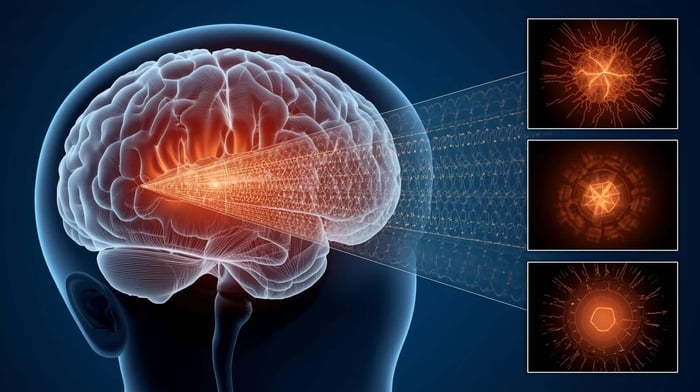
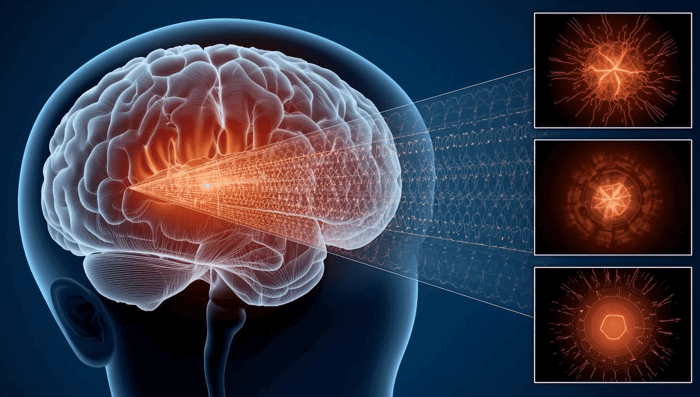
Aura is caused by a slow-moving wave of electrical and chemical activity that travels across the surface of the brain. This process, known as cortical spreading depression (CSD), temporarily alters how affected brain regions function (Charles & Baca, 2013). As this wave moves through the visual cortex, it creates the visual patterns seen in aura.
In most cases, aura occurs before the head pain phase of a migraine, although the two can sometimes overlap. In some cases, the headache phase does not follow. When this happens, it is known as a silent migraine or, clinically, as an acephalgic migraine.
Although the symptoms may appear to come from the eyes or other parts of the body, aura originates within the brain. The experience reflects a temporary disruption in normal signaling rather than a structural problem, which is why symptoms are typically short-lived and follow a predictable pattern.
Why Can Aura Occur Without Pain?
Migraine is best understood as a process that unfolds in stages. While aura and head pain are often linked, they do not always occur together. Each stage reflects different patterns of activity within the brain, and these can vary from one episode to another.
Aura arises from changes in cortical activity, while head pain is associated with activation of deeper pathways, including the trigeminovascular system (TVS) and the release of inflammatory signaling molecules around blood vessels. While these processes are related, they are not dependent on one another.
In some cases, the wave of cortical activity that produces aura does not go on to trigger the processes that lead to pain. This may reflect differences in sensitivity, threshold levels, or how strongly different brain networks are engaged.
Migraine can be understood as a condition involving fluctuating thresholds of brain excitability. When this threshold is lowered, the brain becomes more susceptible to events such as cortical spreading depression, although the extent to which this activity spreads or interacts with pain pathways can vary.
This helps explain why aura can sometimes occur on its own. The brain has entered a state that allows the electrical wave to develop, but not one that fully activates the systems responsible for head pain.
Is Aura Without Migraine Usually Dangerous?
In most cases, having aura without headache is not considered dangerous and does not indicate structural damage to the brain. It reflects the same underlying brain process seen in migraine with headache, but without the activation of pain pathways. The symptoms can feel unusual or concerning, especially when they affect vision or sensation, but they usually follow a well-defined neurological pattern that becomes familiar over time.
One of the key reasons aura is generally not considered dangerous is how these symptoms develop and resolve. They tend to come on gradually, spread or evolve over several minutes, and then fully pass. This pattern reflects the movement of the underlying wave of activity across the brain, rather than a sudden or disruptive event. Because of this, aura can be seen as a temporary change in brain function, rather than a sign of structural damage.
When aura without headache occurs repeatedly, the pattern often becomes familiar over time. Although symptoms may vary slightly from episode to episode, they usually follow a similar sequence and duration. This consistency helps make the pattern easier to recognize.
While aura itself is not typically harmful, it is still important to consider the broader context in which it occurs. Changes in frequency, pattern, or symptom type can sometimes reflect shifts in how the brain is functioning. This is why understanding the overall pattern, rather than focusing on a single episode, is key to interpreting what aura means in each individual case.
When Aura May Need Closer Attention
While aura is usually not considered dangerous, it is still important to interpret it in context. The pattern, timing, and type of symptoms all help shape how an episode is interpreted.
Certain situations may stand out. These include a first episode later in life, symptoms that begin suddenly rather than developing gradually, changes in the usual pattern of aura, or symptoms that last longer than expected or do not fully resolve.
The nature of aura symptoms can also vary. While visual changes are the most common, differences in how symptoms appear, spread, or evolve over time can reflect changes in how the underlying brain activity is unfolding.
These differences do not necessarily mean that something is wrong, but they are part of how aura is interpreted in a broader context. As with other aspects of migraine, patterns and consistency over time are often more informative than any single episode.
How Aura Differs from Other Neurological Events
Migraine aura can sometimes be confused with other neurological events, particularly when symptoms affect vision, sensation, or speech. While these experiences may appear similar on the surface, the underlying patterns are often quite different. This can include events such as transient neurological episodes or disruptions in blood flow that affect how the brain processes sensory information.
One of the key distinguishing features of aura is how symptoms develop over time. They typically begin gradually, spread across the visual field or body, and evolve over several minutes before resolving (Goadsby et al., 2017). This progression reflects the movement of the underlying wave of activity across the brain.
In contrast, other neurological events are more likely to begin suddenly, without a clear progression or spread. Symptoms may appear all at once rather than building over time, and may not follow a consistent or repeatable pattern. In some cases, they may also persist rather than fully resolve.
Another key difference is that migraine aura is usually fully reversible and resolves within a short period of time. Symptoms pass on their own and do not leave lasting neurological changes. Many people also notice that their aura follows a similar sequence, making it more recognizable.
These distinctions are based on patterns rather than any single feature. Gradual onset, progression, and full resolution are all characteristic of aura, while sudden or atypical presentations may reflect a different underlying process.
See also: Migraine vs tension headache, cluster headache vs migraine, and sinus headache vs migraine.
Why Aura Can Occur More Frequently Over Time
Changes in how often aura occurs are not random, but reflect shifts in how stable the brain’s underlying systems are over time.
Migraine can be understood as involving a threshold for brain excitability, with the brain becoming more or less sensitive to changes in activity over time. When this threshold is relatively stable, aura tends to occur less frequently. When this threshold is lowered, it becomes more susceptible to the wave of activity that leads to aura.
This shift is often not due to a single factor, but to a cumulative effect. A range of influences can place strain on the systems that support stable brain function, gradually lowering the threshold at which cortical activity becomes unstable.
These influences include metabolic stress, disrupted sleep, changes in energy availability, hormonal fluctuations, and environmental factors. Rather than acting in isolation, they can combine to increase the overall load on the brain.
As this load builds, the brain becomes more sensitive to internal and external changes. In this state, the underlying processes that produce aura are more easily triggered, leading to an increase in how frequently aura occurs.
The Role of Energy, Metabolism, and Oxidative Stress
The brain has high, constant energy demands, and maintaining stable electrical activity requires a continuous supply of energy, supported by mitochondrial function and the production of ATP. When this energy supply is consistent, brain signaling remains stable, but when it is disrupted, the systems that regulate activity become more vulnerable to instability.
This helps explain why metabolic factors play such an important role in migraine (Russo et al., 2012). Changes in energy availability, whether related to nutrition, sleep, or physiological stress, affect how reliably the brain maintains normal signaling. Over time, this can lower the threshold at which cortical activity becomes unstable.
Oxidative stress also plays a role in this picture. It affects how efficiently mitochondria produce energy, thereby reducing the brain’s ability to meet its energy demands. In this state, the balance between energy supply and demand becomes harder to maintain.
When energy production is less efficient and oxidative load is higher, the brain is more susceptible to the wave of activity that spreads across the cortex and produces aura. This reflects a shift in how well the brain is able to maintain stability under changing conditions.
Why Aura Patterns Matter More Than Individual Episodes
Individual aura episodes can feel significant, particularly when symptoms are unfamiliar or unexpected. Migraine is best understood as a pattern-based condition, as its meaning is found in how symptoms occur and evolve over time rather than in any single event.
This is why frequency, timing, and consistency are so important. A single episode provides limited information, while repeated experiences help reveal a more recognizable pattern. Over time, patterns emerge in how aura begins, spreads, and resolves.
These patterns also reflect changes in the underlying factors discussed earlier. Variations in sleep, energy availability, stress, and hormonal state all influence how frequently aura occurs and how it presents. In this way, aura can be understood as part of a broader pattern of brain responsiveness rather than an isolated event.
Understanding this pattern helps reduce uncertainty. Rather than focusing on a single episode in isolation, it becomes possible to view aura as part of an ongoing process, shaped by changes in brain stability over time.
Supporting Brain Stability with Brain Ritual®
Energy metabolism and oxidative balance play an important role in maintaining stable brain activity over time. When energy supply is more consistent, the brain is better able to maintain stable signaling under changing conditions.
Brain Ritual® is designed to support these underlying processes. It combines exogenous ketone bodies, magnesium, riboflavin (vitamin B2), CoQ10, and key electrolytes and trace minerals, all of which are involved in energy production and cellular resilience. These ingredients have been studied for their role in supporting mitochondrial function and helping to maintain the balance between energy supply and demand in the brain.
steady energy availability and reduce metabolic strain, it supports a balanced environment for normal brain activity.
You can find more information about Brain Ritual, including how to purchase, here.
Brain Ritual® is a medical food designed for the dietary management of migraine. It is not intended to diagnose, treat, cure, or prevent any disease.
Final Thoughts
Migraine aura without headache can feel unusual, particularly when it occurs on its own. This often leads people to ask whether migraine aura without headache is dangerous.
In most cases, it is not considered dangerous. Aura reflects a temporary change in brain activity rather than a structural problem, and tends to follow a recognizable pattern that develops gradually and resolves over a short period of time.
Looking at the broader pattern over time is more helpful than focusing on any single episode. Frequency, consistency, and the way symptoms evolve all provide important context. When viewed this way, aura is less about isolated events and more about how the brain responds under different conditions.
Across this article, a consistent theme has emerged. Aura is linked to changes in brain stability and is influenced by factors such as energy availability, metabolic stress, sleep, and hormonal state. These influences do not act in isolation. Together, they contribute to the overall load on the brain. This shapes how susceptible it is to the wave of activity that produces aura.
Over time, this pattern often becomes easier to recognize. Rather than something unpredictable or inherently dangerous, aura can be understood as part of how the brain responds to changes in stability under different conditions.