
Table of Contents
- At a Glance
- What Is Migraine Aura?
- Types of Migraine Aura (visual, sensory, and language)
- The Wave in the Brain (The Mechanism Behind Aura Migraine)
- Why Visual Aura Appears the Way It Does
- Why Aura Moves Slowly
- What Sensory and Speech Aura Feel Like
- Aura Without Headache
- Changes in Aura Frequency
- When Aura Warrants Further Evaluation
- What Aura Reveals About Migraine
- The Role of Brain Energy and Aura
- Final Thoughts
At a Glance
|
Migraine aura is one of the most distinctive yet misunderstood features of migraine. Around one in four people with migraine experience aura (Lucas, 2021), and for those affected, the symptoms can be striking: shimmering visual patterns, blind spots, tingling sensations, or brief difficulty speaking.
Despite how vivid these changes can feel, migraine aura reflects a temporary shift in brain activity rather than a problem with the eyes or damage to the brain itself. It typically develops gradually, spreads across the visual field or through sensory regions of the body, and then usually resolves within about 20 to 30 minutes.
Understanding how and why migraine aura unfolds in this structured way can make the experience easier to interpret. What follows explains what migraine aura is, why it moves as it does, how it varies between individuals, and when changes in pattern warrant further evaluation.
What Is Migraine Aura?
Migraine aura is a temporary change in how the brain processes sensory information. During aura, people often notice shimmering patterns, blind spots, tingling, or brief difficulty speaking. It reflects a shift in brain activity rather than a problem in the sensory organs themselves, so perception becomes distorted even though the organs are unaffected.
Although aura usually appears shortly before a migraine attack, it can also occur during the headache or by itself without pain, while still reflecting migraine activity in the brain. It unfolds over several minutes, moving across part of the visual field or body before fully resolving. This gradual progression is one of its defining features and helps distinguish it from conditions that begin abruptly, such as stroke or transient ischemic attack.
Aura involves changes in processing rather than structure, with no actual damage occurring during the episode. As this change happens, signals are interpreted differently, producing visual patterns, areas of missing vision, tingling sensations, or difficulty finding words. All arise from the same underlying process taking place in different brain regions.
This way of viewing aura can help you make better sense of the experience. It is not a separate condition from migraine and not a problem with the eye itself. It is a phase of migraine in which perception changes before the brain returns to its usual state.
Types of Migraine Aura (visual, sensory, and language)
Aura arises from the same underlying process, with the experience shaped by the brain region involved (Pietrobon & Moskowitz, 2013). Because each region handles a different type of information, what you notice changes depending on where the activity spreads.
Visual aura is the most common form. People often see shimmering zigzag lines, flashing lights, expanding shapes, or small gaps in vision. The pattern typically begins in a small area and gradually moves across the visual field, most often resolving within about 20 to 30 minutes, though the recognized range is five to 60 minutes. Because this activity occurs in the visual cortex, the eyes themselves are unaffected even though vision appears altered. This phenomenon is also known as ocular migraine aura, though the changes originate in the visual areas of the brain rather than the eye itself.
Sensory aura affects physical sensation rather than sight. Tingling commonly starts in the fingers or hand, then slowly travels up the arm and sometimes reaches the face or lips. As it spreads, the affected area may feel slightly numb. This orderly progression reflects activity passing through adjacent regions of the brain’s sensory map (where the brain tracks body sensations), where areas representing the hand and face lie close together, rather than a problem in the skin or peripheral nerves. Sensory aura usually unfolds over a similar time frame to visual aura, often resolving within 10 to 30 minutes.
Language aura involves temporary difficulty speaking or understanding words. People may know what they want to say but struggle to find the right terms, mix up sounds, or even pause mid-sentence. This occurs when migraine-related activity involves language-processing areas of the brain. Language aura episodes are often shorter than visual and sensory forms, sometimes lasting only five to 20 minutes.
These forms can occur separately or in sequence during the same episode. The way they unfold over time and fully resolve afterward is characteristic of migraine auras.
Less common aura variants, such as brainstem aura or motor aura, can involve additional neurological symptoms including vertigo, double vision, or temporary weakness, though visual, sensory, and language forms are most typical.
The Wave in the Brain (The Mechanism Behind Aura Migraine)
Migraine aura follows a distinct pattern. Initially, a change in brain activity begins in a small area and moves slowly across the cortex like a wave. As this happens, the affected area briefly becomes more active, followed by a short period of reduced responsiveness.
The wave travels slowly, moving only a few millimeters each minute. Because different brain regions handle different kinds of information, the way an aura is experienced changes as the activity reaches new areas. When it begins in visual regions, people notice moving patterns in vision. If it reaches sensory regions, tingling or numbness appears. When it involves language regions, speech becomes harder to organize.
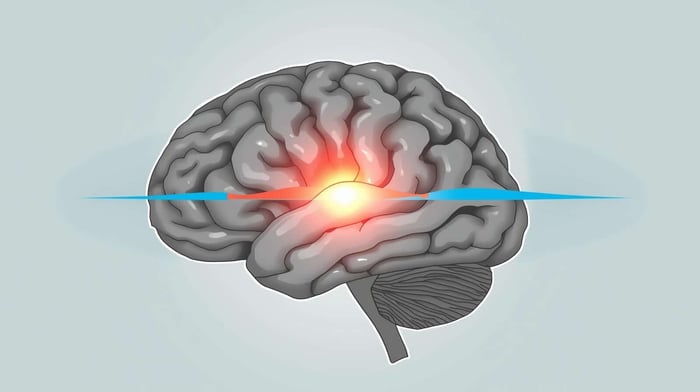
The wave does not damage brain tissue (Charles & Baca, 2013). Instead, it alters how signals are processed as it passes through, after which normal activity returns. The gradual build, movement, and resolution of aura reflect this travelling shift in activity rather than a structural problem in the brain.
Understanding this wave-like movement helps explain why aura feels structured rather than chaotic. The symptoms change in sequence because the brain regions involved also change in sequence.
Why Visual Aura Appears the Way It Does
Visual aura has a distinctive appearance. This is because the visual cortex is organized like a map of the world around you. Areas that sit next to each other in the brain represent places that sit next to each other in the visual field. As the wave of activity moves across this map, the changes in perception move with it, creating patterns that seem to travel across your vision rather than appearing all at once.
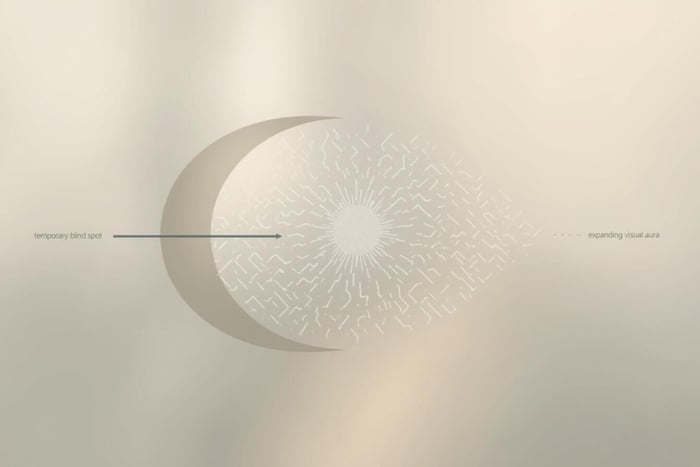
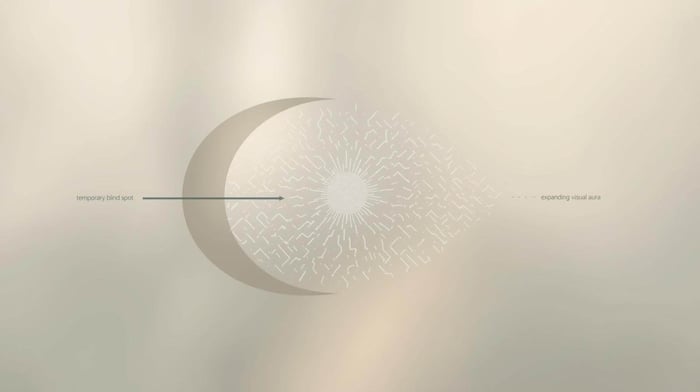
Many people first notice a small shimmering point or blind spot near the center of sight. Over several minutes this expands outward, often forming zigzag or crescent shapes with flickering or sparkling edges. This motion feels slow and predictable because the activity is moving gradually across the cortex.
These expanding zigzag or crescent shapes tend to look clear and follow geometric patterns rather than appearing as vague blurs. Lines, angles, and repeating forms arise because the brain processes vision in an orderly spatial layout. The eyes continue to receive normal light signals, but the brain briefly interprets them differently as the wave passes through (O’Hare et al., 2021).
You may notice that covering one eye does not remove the disturbance. This occurs because the source of the aura lies in the brain rather than the eye. Once the wave moves on, the visual field returns to normal without leaving damage behind.
Why Aura Moves Slowly
One of the noticeable features of migraine aura is its pace. The disturbance does not appear instantly. Instead, it spreads gradually over time, often taking five to 60 minutes from start to finish.
This slow progression reflects the speed of the underlying wave of brain activity. The change does not jump between areas but moves step by step across neighboring regions of the cortex. Because each part of the brain processes a different type of information, migraine aura symptoms shift gradually rather than all at once.
The steady pace and direction help explain why aura feels predictable. A visual disturbance may expand outward, tingling may travel along the arm, or words may become harder to form, each unfolding in an ordered sequence as the wave advances.
This timing helps distinguish aura from many other neurological events, which typically begin more suddenly and do not resolve in the same gradual way.
What Sensory and Speech Aura Feel Like
Not all aura affects vision. For some, the first change is a physical sensation or a shift in speech rather than a visual symptom.
Sensory aura often begins as tingling in the fingers or hand. Over several minutes it may travel up the arm and sometimes reach the face or lips. As the migraine aura moves, the earlier affected area may feel slightly numb. This gradual movement follows a similar pattern to visual aura, reflecting activity passing through neighboring sensory regions of the brain.
Speech changes can occur if the aura reaches parts of the brain responsible for language. Words may become harder to find, sentences come out jumbled, or you pause unexpectedly while speaking. Thoughts themselves remain clear, but expressing them is temporarily difficult.
Since these changes develop step by step and then fully resolve, they can feel strange yet structured. Understanding this pattern can help distinguish them from sudden communication problems that arise for other neurological reasons.
Aura Without Headache
Aura does not always lead to head pain. For some, the visual, sensory, or speech changes occur and fully resolve without a headache developing. This phenomenon is sometimes referred to as a migraine aura without headache.
The overall experience still follows the same pattern seen in more typical aura migraines. The changes begin gradually, move across vision or sensation, and then fully resolve within the usual time frame. Without the headache to identify it as migraine, the episode can feel confusing or even alarming the first few times it happens.
This form of migraine becomes more common with age, especially in people who had typical migraine attacks with headache earlier in life. The brain activity underlying the aura remains the same, but it no longer consistently triggers the pain phase.
Once you have experienced and recognize these patterns, the episode often feels less alarming.
Changes in Aura Frequency
Aura does not always occur in the same way. Some people experience long gaps between episodes, while others go through periods when aura happens more frequently.
Occasionally, more than one aura can occur within a short time span. Each episode unfolds in its usual gradual way, but the brain enters an aura state again much sooner than expected. This can feel unusual, especially if you are used to having only occasional attacks.
Changes in frequency do not necessarily mean the aura itself has changed. The underlying mechanism remains the same, though episodes may occur closer together or at less predictable intervals.
Tracking when aura occurs can sometimes reveal patterns. Sleep disruption, stress, illness, or hormonal changes may influence how often the brain enters this state, without changing the nature of the aura itself.
Although the underlying process is the same, aura can intersect with other factors. Some people notice links with hormonal changes, while others wonder whether aura itself can be dangerous. Exploring these related questions can help you better understand how aura fits into your own experience.
When Aura Warrants Further Evaluation
Migraine aura follows a recognizable pattern. It develops gradually, spreads over several minutes, and then fully resolves.
If your aura pattern changes in a way that feels unfamiliar, you may wish to seek advice. Aura that begins suddenly without gradual spread, lasts longer than 60 minutes, or does not fully resolve should be evaluated. A significant change in how aura feels compared with previous episodes is also worth discussing with a healthcare professional.
Aura occurring for the first time later in life, particularly without a prior history of migraine, should be assessed to rule out other causes. Similarly, new neurological symptoms that do not follow the familiar structured progression described earlier should not automatically be assumed to be migraine.
Seeking medical advice in these situations does not necessarily mean something serious is happening and can help to exclude other causes.
What Aura Reveals About Migraine
Migraine aura offers a unique window into how migraine works. Unlike head pain, which can feel diffuse and harder to interpret, aura follows a visible or measurable sequence.
The gradual spread of symptoms across vision, sensation, or language demonstrates that migraine is not simply a headache but a coordinated change in brain activity. Each shift reflects activity moving across connected regions of the cortex, producing the ordered progression described earlier.
Because aura can occur with or without head pain, it also reinforces that migraine is a broader neurological state rather than a condition defined by pain alone. The same underlying mechanism may unfold differently depending on which brain networks are involved.
In this way, aura highlights what pain alone can obscure: migraine is a temporary, structured change in brain function that resolves once normal processing returns.
For a broader understanding of migraine mechanisms and management, you may also find these guides helpful: What Causes Migraines; how nutrition influences migraine patterns; research into roles of magnesium and riboflavin in migraine; how to approach an elimination diet for migraine; and practical ways to manage a migraine at home.
The Role of Brain Energy and Aura
An energy deficit can trigger migraine aura because when the brain does not have enough ATP available, neurons struggle to maintain stable electrical gradients. This makes the cortex more vulnerable to cortical spreading depression, a slow-moving wave of depolarization believed to underlie migraine aura. In this state, common stressors such as fasting, sleep deprivation, or metabolic strain can lower the threshold for an aura to begin.
Aura is not only triggered by impaired energy supply, it also places additional demands on the brain’s energy systems. Once cortical spreading depression occurs, the brain must use significant energy to restore normal cellular function. As a result, aura is both a consequence of low energy availability and a process that further taxes the brain’s metabolic reserves.
For this reason, attention has turned toward supporting brain energy and resilience. This includes nutrients involved in mitochondrial function, antioxidant defense, and cellular energy production, which help support more stable neural activity over time.
Brain Ritual® was developed to support brain energy metabolism through science-backed ingredients designed to participate in cellular energy and antioxidant pathways. Its formula includes exogenous ketone bodies alongside key micronutrients that support cellular energy production and antioxidant function. By providing an alternative fuel source for the brain, ketones may help support metabolic stability in individuals who are sensitive to fluctuations in energy demand.
Brain Ritual® is available for purchase here.
Disclaimer: Brain Ritual® is a medical food for the dietary management of migraine and is not intended to diagnose, treat, cure, or prevent any disease. This content is for informational and educational purposes only and is not intended as medical advice.
Final Thoughts
Migraine aura can feel alarming the first time it happens even though it follows a consistent and recognizable pattern. Understanding that the gradual spread of visual, sensory, or language changes reflects a temporary shift in brain activity rather than damage to the eyes or brain tissue often makes the experience less frightening.
Many people experience migraine without aura, with head pain occurring without the visual, sensory, or speech changes described here. Aura represents one expression of the broader neurological process that defines migraine. Whether pain appears alone or alongside sensory changes depends on which brain networks are involved during an episode.
You may be wondering how to get rid of migraine aura once it begins. Aura reflects a wave of activity moving across the brain and typically resolves on its own within five to 60 minutes. There is no reliable way to abruptly stop it once underway. Recognizing its predictable progression can help reduce anxiety during the episode.
Seen in this light, aura is not random or chaotic. It is a temporary and reversible phase of migraine that illustrates how sensitive and interconnected the brain’s networks are under certain conditions.