
Table of Contents
At a Glance
|
Hormonal migraines tend to follow a pattern, with symptoms appearing at similar points in the cycle or during periods of hormonal change. These patterns usually become clearer over time, especially when viewed across several cycles or life stages such as pregnancy or perimenopause.
These patterns are not always obvious at first. Hormonal migraines often reflect shifting internal conditions, rather than a single trigger.
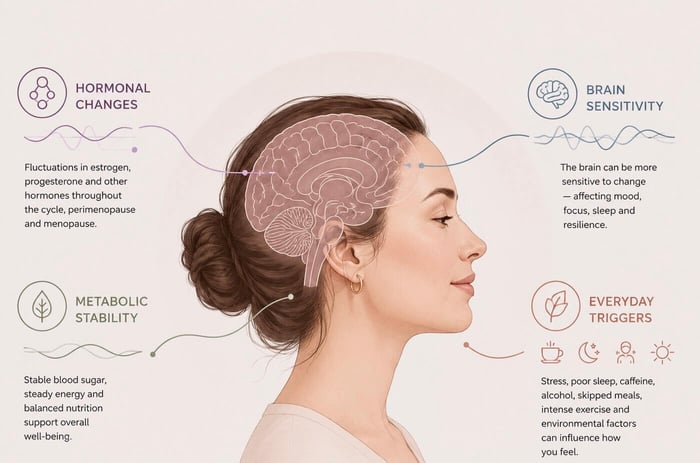
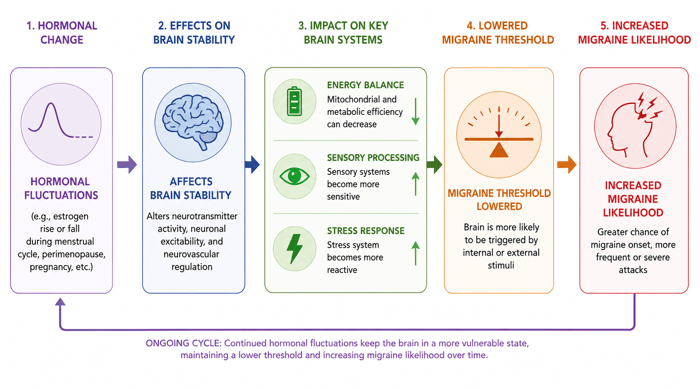
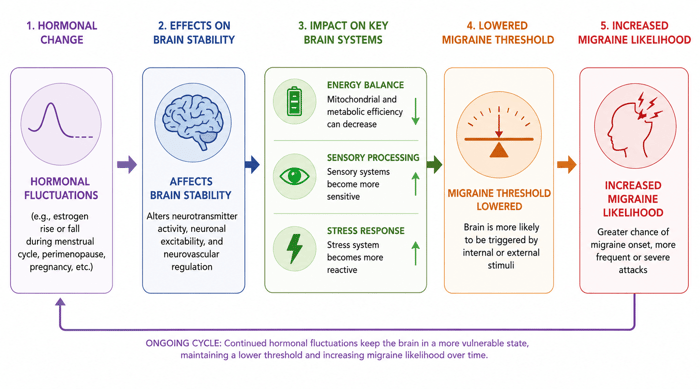
Hormonal changes affect several processes linked to migraine, including energy balance, sensory sensitivity, and the body’s response to stress. When underlying systems are stable, the brain is better able to maintain normal function. When they are disrupted, the threshold for migraine is lower.
By understanding hormonal migraines, it becomes easier to see how they can feel predictable, how they change over time, and why they do not always follow a simple pattern.
Why Hormonal Changes Can Trigger Migraine
Hormonal changes can affect the brain’s stability, especially during periods of transition. Hormones such as estrogen, progesterone, and cortisol influence several processes linked to migraine, including brain energy balance, sensory processing, and the body’s response to stress (Sacco et al., 2012).
When these systems are working smoothly, the brain is better able to maintain stable function. Rapid changes in hormone levels can temporarily disrupt this stability, and often the speed and direction of change, rather than the absolute level, matter most.
During periods of hormonal fluctuation, the brain may become more sensitive to internal and external signals. This can lower the threshold at which a migraine begins, making an attack more likely.
This does not mean hormonal changes directly cause migraine. They are just one of several factors that influence how easily the brain shifts into a migraine state.
Common Hormonal Migraine Patterns
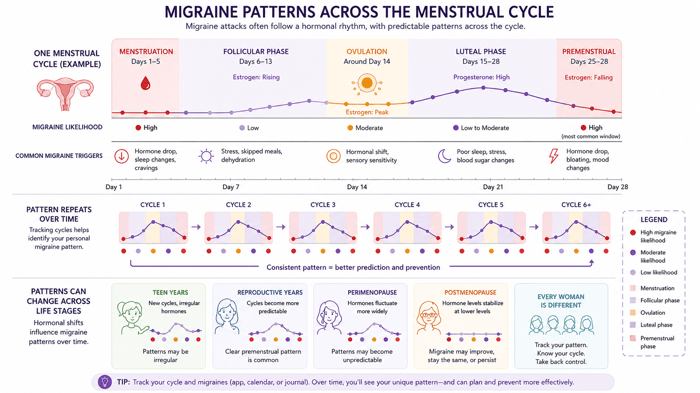
Hormonal migraines are best understood as patterns that emerge over time, rather than as isolated events. In many cases, attacks begin to follow a predictable rhythm, often repeating across cycles or life stages.
Recognizing these patterns is often the first step in understanding whether hormones are contributing to migraine.
These patterns reflect how the brain responds to changes in hormone levels, especially when those shifts affect energy balance, sensory processing, or overall stability. While they vary from person to person, a few common patterns still tend to emerge.
Before or During Your Period
One of the most widely recognized menstrual migraine patterns occurs in the days leading up to menstruation or in the first few days of a period.
This timing is closely linked to the natural drop in estrogen that occurs at the end of the menstrual cycle (MacGregor et al., 2007; Nappi et al., 2022). For some people, this shift is enough to lower the brain’s stability threshold, making a migraine more likely.
Attacks during this phase are:
Consistent from month to month
Clustered over several days rather than a single episode
Hormonal migraines can last from several hours to a few days
Can be difficult to shift once they begin
Because this pattern is tied to a regular hormonal cycle, it is often one of the easiest to recognize.
Around Ovulation
Some people experience migraines mid-cycle, around the time of ovulation.
This phase involves a shorter, more subtle hormonal shift compared to the premenstrual drop. This pattern may be less obvious, but it can still repeat.
During the ovulation window:
Hormone levels are changing rather than remaining stable
Sensitivity to migraine may increase briefly
Attacks may feel less predictable, but still follow a loose monthly rhythm
This pattern is less common, but it shows that the brain can respond to smaller shifts, not just major hormonal changes.
During Pregnancy and After Birth
Hormonal migraine patterns often change significantly during pregnancy.
For many people, migraines become less frequent or may stop altogether. This reflects a more stable hormonal environment, particularly in the later stages of pregnancy.
During pregnancy, estrogen and progesterone levels rise substantially. Estrogen, in particular, has antioxidant effects that may help protect against oxidative stress and free radicals. This may support a more stable neurological environment and could be one reason migraine improves for some people during pregnancy.
After giving birth, hormone levels shift rapidly. This can lead to changes such as:
The return of migraine after a period of improvement
Increased sensitivity in the early postpartum period (the weeks after birth)
This contrast between stability and rapid change highlights a key idea: it is often the shift in hormones, rather than their absolute level, that matters most.
During Perimenopause
Migraine patterns often shift during perimenopause. Instead of a predictable monthly rhythm, hormone levels tend to fluctuate irregularly. This can lead to:
Less predictable timing of attacks
Changes in frequency or intensity
Periods of relative stability, followed by increased sensitivity
For some, migraines may become more frequent during this phase, then stabilize. This reflects a broader shift in the body, where hormone levels become less consistent.
How to Tell If Your Migraines Are Hormonal
Hormonal migraines are not defined by a single symptom. Instead, the key is recognizing how patterns appear and repeat over time.
In many cases, the most useful clues that migraines may be hormonal come from when they occur, how they cluster, and how they change across life stages.
Signs Your Migraines May Be Linked to Hormones
You may notice:
Migraines occurring at similar points in your cycle, such as before your period or around ovulation
Attacks clustering over several days rather than appearing as isolated events
Changes in migraine frequency or intensity at different life stages, such as pregnancy or perimenopause
A pattern that repeats over time, even as individual attacks vary
Rather than focusing on a single attack, it is more helpful to look for consistent patterns across cycles.
Why Timing Matters More Than Individual Symptoms
Hormonal migraines do not necessarily feel different from other migraines. The key difference is often not the symptoms themselves, but when they occur.
A migraine that appears at the same point in each cycle, or follows a similar pattern over time, is more likely to reflect an underlying hormonal influence.
This is why tracking your patterns over weeks or months can provide more clarity than focusing on a single episode.
When Patterns Are Less Clear
Not all hormonal patterns are easy to recognize.
Some people have irregular cycles, overlapping triggers, or patterns that shift over time. In these cases, migraines may still be influenced by hormonal changes, but the connection is less obvious.
This does not mean hormones are not involved, only that the pattern may be harder to recognize.
While hormonal changes can also influence migraine in men, these effects are typically less cyclical and less predictable. They may relate more to longer-term shifts, such as aging, or to more general factors like stress and sleep, which can make patterns harder to recognize.
Why Hormonal Migraines Often Feel Different
Hormonal migraines do not always have unique symptoms, but they can feel different depending on the context in which they occur. The location of pain is not usually distinct, and may feel similar to other types of migraine.
One reason for this is timing. Migraines that follow a hormonal pattern often appear when the brain is more sensitive, such as during hormonal shifts. This can make attacks feel more intense, more persistent, or harder to predict.
Hormonal changes can also influence how the brain processes sensory information. During certain hormonal phases, sensitivity to light, sound, or movement may increase, which can make a migraine feel more disruptive even if the underlying symptoms are similar.
In some cases, hormonal migraines may also be accompanied by broader changes in how you feel. Fatigue, changes in mood, or reduced tolerance to stress can occur alongside migraine, reflecting the broader effects of hormonal shifts on the body.
Hormones Do Not Act Alone
Although hormones are an important part of the picture, they are not the only factor that influences migraine.
Instead, hormonal changes can be understood as one of several influences that affect the brain’s overall stability. These include factors such as sleep, stress, nutrition, and sensory load, which can combine to influence migraine (see also: Understanding Migraine Triggers).
This is why hormonal migraines do not usually occur in isolation. A hormonal shift may increase sensitivity, but whether a migraine actually develops often depends on what else is happening at that time.
For example, a hormonal change that might not trigger a migraine on its own may do so when combined with poor sleep, dehydration, or higher stress levels. Nutritional factors can also influence how the brain responds under these conditions (see also: Nutrition and Migraine; Magnesium and Riboflavin Migraines).
This reflects a common feature of migraine, where multiple factors combine to push the brain past a certain threshold. Hormones can influence that threshold, but they are only one part of a more complex system (see also: What Causes Migraines; Hormones and Migraines: Full Guide).
How Hormonal Migraine Patterns Change Over Time
Hormonal migraine patterns are not fixed. You may notice that they change over time, reflecting shifts in the body’s internal balance and overall sensitivity.
The influence of hormones on migraine often changes at different stages of life. During puberty, for example, migraine patterns may begin to appear as hormonal cycling starts. In early adulthood, these patterns may become more established and easier to recognize.
Pregnancy can bring a period of relative stability, while the weeks after birth often involve rapid hormonal changes that may increase sensitivity again. Later in life, during perimenopause, patterns may become more variable and less predictable. Hormonal medications, including birth control or hormone therapy, can also influence migraine patterns by changing how hormone levels rise, fall, or remain steady. Some people may notice hormonal headaches in perimenopause during this phase, before patterns eventually stabilize.
These changes are not driven by a single factor, but by shifts in how the brain responds to hormones over time. Other influences, such as sleep or stress, can also shape how these patterns change.
A pattern that feels clear at one stage of life may look different at another. This helps explain why migraines may seem to change, even when the underlying mechanisms are similar.
When to Pay Closer Attention
Hormonal migraine patterns are often predictable and follow familiar cycles. In many cases, they reflect temporary changes in brain activity rather than a sign of a more serious problem.
Patterns are not always easy to recognize. Irregular cycles, overlapping triggers, or the variability seen during perimenopause can make them less consistent and more difficult to interpret.
It can be helpful to pay closer attention when patterns change in unexpected ways, as this may reflect a shift in how the brain is responding or signal that other factors are involved.
For example:
A sudden and significant change in your usual migraine pattern
New neurological symptoms that you have not experienced before
A noticeable increase in how often migraines occur, or how severe they feel over a short period of time
These changes do not necessarily indicate a serious issue, but they may point to a change in how the brain is responding or suggest that other factors are involved.
If something feels different from your usual pattern, it can help to seek further advice.
Supporting Brain Stability
Hormonal migraines reflect shifts in how the brain responds to changing internal conditions, particularly when overall brain stability is reduced. Because the brain has high energy demands, maintaining consistent energy availability can support more stable function.
Brain Ritual® is designed to support stable brain function and includes key nutrients involved in brain energy metabolism, such as exogenous ketone bodies, magnesium, riboflavin, and CoQ10. Ketone bodies can provide an alternative fuel source for the brain when energy demand is high, helping to support more consistent energy availability.
These nutrients are also involved in mitochondrial function and oxidative balance. During periods of increased stress or fluctuation, oxidative stress can place additional strain on the brain’s ability to maintain stable signaling. Supporting energy production alongside oxidative balance may help the brain function more consistently under these conditions.
By supporting energy balance and metabolic stability, Brain Ritual® helps the brain maintain more consistent signaling, particularly during periods when hormonal fluctuations may increase sensitivity. You can purchase Brain Ritual® here.
Brain Ritual® is a medical food designed for the dietary management of migraine. It is not intended to diagnose, treat, cure, or prevent any disease.
Final Thoughts
Hormonal migraines are best understood as patterns that emerge over time, rather than as isolated events. While they are often linked to the menstrual cycle or different life stages, they do not always follow a simple or predictable path.
Hormonal changes influence how the brain responds, but they are only one part of the picture. Factors such as sleep, stress, and overall health can all shape how these patterns develop and change over time.
Focusing on your patterns, rather than individual episodes, can help you better understand what may be contributing to your migraines and how they change over time.